
By Desmond Ogbonmwan
LAGOS, Nigeria —
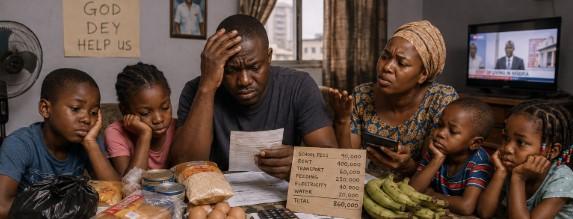
By 4:45 every morning, while much of Lagos is still asleep, 41-year-old Chinedu Okafor is already awake.
Not because he wants to be.
Because he has to be.
His alarm rings before dawn, but he is usually awake before it sounds. Bills have a way of interrupting sleep.
He quietly leaves the mattress he shares with his wife, making sure not to wake their four children sleeping beside each other in the small two-bedroom apartment they rent in the Agege area of Lagos.
For the next few minutes, the house is silent.
Then reality returns.
School fees.
Transport.
Electricity.
Rent.
Food.
Medical bills.
Data subscription.
Fuel.
Every one of those expenses is waiting for him before the day has even begun.
“I don’t wake up thinking about myself anymore,” he says.
“I wake up calculating.”
The Calculator Never Leaves the Table
Like many fathers across Lagos, Chinedu no longer budgets monthly.
He budgets daily.
The calculator on his dining table has become one of the most important items in his home.
Every evening, he writes down what came in.
Then he writes what went out.
Most days, the second number is bigger than the first.
“There was a time I used to save money.”
“Now my prayer is simply not to borrow.”
Breakfast Has Changed
Three years ago, breakfast in their home was different.
Bread.
Eggs.
Tea.
Sometimes cereal for the children.
Today, those meals have become occasional luxuries.
His wife, Ngozi, now stretches every food item she buys.
Instead of one loaf lasting two days, she carefully divides it so it survives almost four.
Milk is measured.
Sugar is measured.
Cooking gas is monitored almost like fuel in a generator.
Nothing is wasted anymore.
“You don’t realize how expensive living has become until you have children asking for things you genuinely cannot afford,” she says quietly.
“Daddy, Can We Buy Chicken Today?”
The hardest conversations happen around food.
His youngest son recently pointed at a fast-food restaurant while returning from school.
“Daddy, can we buy chicken today?”
Chinedu smiled.
He promised, “Next time.”
He already knew there probably wouldn’t be a next time.
“It breaks you.”
“You don’t want your children to think you’re saying no because you don’t love them.”
“Sometimes you’re saying no because that’s the only way everybody eats tomorrow.”
School Fees Arrive Faster Than Salaries
Education remains non-negotiable.
Despite the financial pressure, Chinedu insists his children must remain in school.
He remembers his own childhood and believes education remains the family’s greatest chance of breaking the cycle of poverty.
But paying school fees has become one of his greatest challenges.
Some schools now request payments in advance.
Books cost more.
Uniforms cost more.
Transport costs more.
Even simple classroom projects require additional money.
“There are weeks when almost my entire income disappears because of school expenses.”
“You pay one child.”
“The second one is waiting.”
“Before you’re done, another term has started.”
The Hidden Cost Nobody Talks About
Food prices dominate public discussions.
Fuel prices dominate the headlines.
Electricity tariffs receive attention.
But Chinedu believes something else has become even more expensive.
Peace of mind.
“You leave home wondering if today’s money will be enough.”
“You come back home wondering what new price has increased.”
“There is no rest.”
Why This Story Matters
Economic reports often discuss inflation using percentages, exchange rates and government data.
Those numbers are important.
But they rarely show what inflation actually looks like inside an ordinary Nigerian home.
Behind every statistic is a family making difficult decisions every day.
Parents skip meals so children can eat.
Households postpone hospital visits.
Birthdays become smaller.
New clothes become less frequent.
Dreams are delayed—not because families lack ambition, but because survival has become the immediate priority.
For millions of Nigerian fathers and mothers, financial planning is no longer about building wealth.
It is about making tomorrow possible.
“Being a Father Has Become More Mental Than Physical”
For Chinedu, the biggest burden is no longer going to work every day.
It is carrying the invisible weight that comes with being responsible for five other people.
He says there are nights when everyone else in the house is asleep, but he remains awake, staring at the ceiling, wondering how he will make the next month’s rent or whether another increase in transport fares or electricity tariffs is around the corner.
“There are days my children think I’m just tired,” he says.
“But I’m actually thinking.”
“Thinking about school fees.”
“Thinking about food.”
“Thinking about whether one emergency can destroy everything we’ve managed to build.”
Mental exhaustion has quietly become one of the biggest challenges facing many Nigerian parents.
Unlike physical labour, emotional stress is often invisible, yet it affects decision-making, productivity and even family relationships.
His Wife Has Become a Second Breadwinner
When they got married nearly 13 years ago, Chinedu believed his salary alone would comfortably take care of the family.
That is no longer possible.
His wife, Ngozi, now operates a small provisions stand in front of their apartment.
She also sells soft drinks, sachet water, noodles and household essentials to neighbours.
On weekends, she fries chin chin and meat pies for nearby shops.
“It’s not because she enjoys doing everything,” Chinedu explains.
“It’s because one income cannot carry six people anymore.”
Many women across Lagos have found themselves in similar situations.
Some braid hair after work.
Others bake cakes from home.
Some sell thrift clothing online.
Others run WhatsApp businesses selling groceries, perfumes and cosmetics.
For many households, these additional sources of income are no longer optional.
They have become necessary for survival.
Every Trip to the Market Comes With Anxiety
Ngozi says going to the market now feels completely different.
She still carries the same shopping list.
The problem is that the prices have changed.
“You can leave home with ₦50,000 thinking it’s enough.”
“By the time you finish buying basic foodstuffs, you realise you’ve bought less than what ₦30,000 used to buy.”
Instead of buying a full basket of tomatoes, she buys fewer.
Instead of purchasing meat for the entire week, she divides it into smaller portions.
Cooking oil is rationed.
Even fruits, once considered a regular part of the children’s meals, are now purchased less frequently.
“We don’t stop buying because we want to.”
“We stop because we have no choice.”
Children Notice More Than Parents Think
Parents often try to shield their children from financial worries.
But children notice changes.
They notice when birthday celebrations become smaller.
They notice when family outings disappear.
They notice when new clothes become Christmas-only events.
They notice when their parents quietly discuss money after they think everyone is asleep.
Child psychologists have long observed that financial stress within households can indirectly influence children’s emotional wellbeing, even when parents make every effort to protect them.
That is why many experts encourage parents to maintain open but age-appropriate conversations with children rather than allowing them to imagine situations that may be worse than reality.
Lagos Is Becoming More Expensive to Raise a Family
Raising children in Lagos has always required planning.
Today, it requires constant adjustment.
Parents now factor in expenses that barely existed a decade ago.
Internet subscriptions for school assignments.
Private lesson fees.
Higher transport fares.
Digital learning materials.
Medical bills.
Rising utility costs.
Security expenses.
Even recreation has become more expensive.
Simple family outings that once offered a break from daily routines are increasingly postponed because they compete with more urgent financial priorities.
Why This Matters
The challenges facing families like Chinedu’s are not isolated cases.
They reflect broader economic realities affecting households across Lagos and other urban centres.
Inflation does not affect everyone equally.
Families with young children often experience greater pressure because education, nutrition, healthcare and transportation consume a significant portion of household income.
As living costs continue to rise, more parents are adjusting spending habits, taking additional jobs and postponing long-term financial goals simply to maintain day-to-day stability.
These experiences rarely appear in economic reports, yet they represent the human side of national economic trends.
The Middle Class Is Feeling the Pressure
Economists often describe Nigeria’s middle class as the engine of consumer spending.
But many households that once considered themselves financially stable now say they are living month-to-month.
Savings accounts are shrinking.
Emergency funds are being used for routine expenses.
Family vacations have disappeared.
Home ownership plans have been postponed.
Some parents who once enrolled children in private schools are now considering more affordable alternatives.
Others delay vehicle maintenance or medical check-ups to prioritise school fees and food.
The result is a growing sense that financial security has become increasingly fragile.
Yet Hope Has Not Disappeared
Despite the daily struggles, Chinedu refuses to describe himself as defeated.
Every morning, he still wakes before sunrise.
He still goes to work.
He still jokes with his children.
He still believes education will open doors that hardship cannot permanently close.
“My children don’t need to remember that I was rich,” he says with a smile.
“They need to remember that I never gave up on them.”
That determination may be one of the most valuable assets many Nigerian families still possess.
Final Thoughts
Across Lagos today, there are thousands of fathers whose stories resemble Chinedu’s.
Different names.
Different occupations.
Different neighbourhoods.
But remarkably similar struggles.
Their stories remind us that economic discussions are ultimately about people—not just inflation rates, exchange rates or GDP figures.
Behind every headline about rising prices is a parent recalculating a household budget.
Behind every statistic is a child whose future depends on difficult decisions made around a kitchen table.
For many Nigerian families, resilience has become a daily practice rather than an occasional act.
And while they continue hoping for economic improvement, they also continue doing what parents everywhere have always done—finding ways to provide, protect and persevere.
Frequently Asked Questions
How much does it cost to raise a family in Lagos today?
Costs vary depending on housing, education, transportation and lifestyle, but many families report that food, rent, school fees and utilities now consume a much larger share of household income than they did a few years ago.
Why are more Nigerian families taking on multiple sources of income?
Rising living costs mean that one salary is often insufficient to cover essential household expenses. Many couples now rely on side businesses, freelance work or informal trading to supplement their income.
How does inflation affect children?
Beyond higher living costs, inflation can affect children’s nutrition, education, recreation and emotional wellbeing when families must reduce spending or postpone important expenses.
Are middle-class families also affected?
Yes. Many households that previously considered themselves financially comfortable now report living paycheck to paycheck because of increasing costs across housing, food, transportation and education.
What lessons can families learn during difficult economic periods?
Financial planning, multiple income streams, prudent spending and strong family communication can help households navigate economic uncertainty while preparing for future opportunities.
Related Stories
“Nobody Wants To Stay Out Late Again” — How Insecurity Is Quietly Destroying Nigeria’s Night Economy