

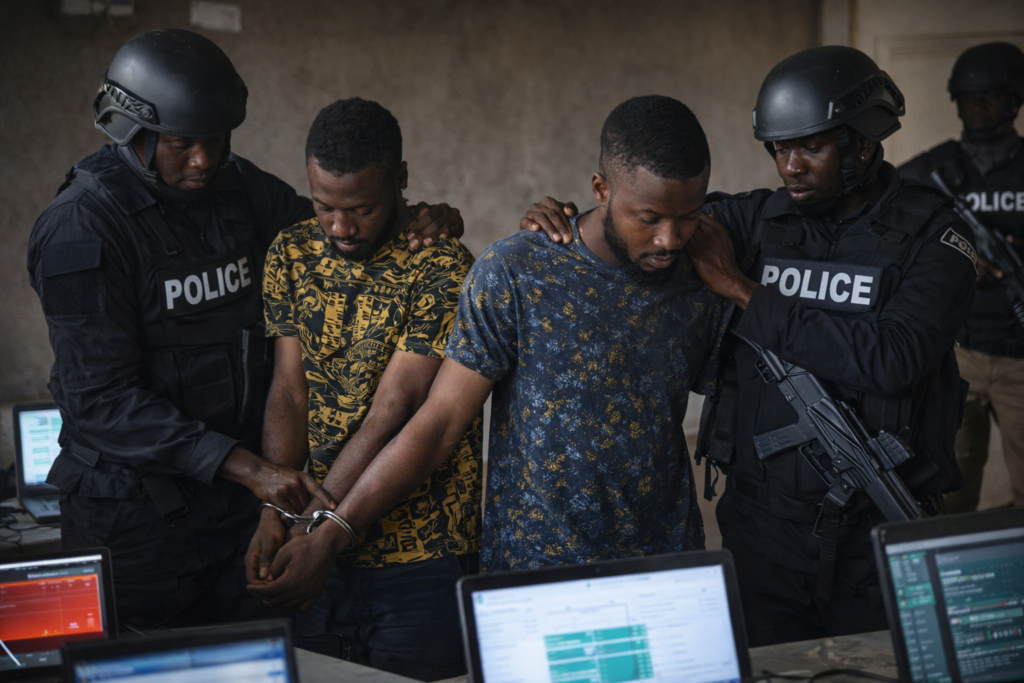
Ghanaian security agencies have arrested nine Nigerians accused of coordinating a network of cybercrime operations from several locations in and around the capital, Accra.
The arrests followed a two-day intelligence-led operation that also led to the detention of 44 other Nigerians believed to be victims of human trafficking and cybercrime exploitation. Authorities say the victims were lured into Ghana under false promises of lucrative job opportunities and later forced into online fraud.
During the raids, security operatives recovered 62 laptops, 52 mobile phones, and two pump-action guns from makeshift offices believed to have been used for criminal operations.
The suspects are currently in the custody of the Ghana Immigration Service as investigations continue.
How the Operation Unfolded
The arrests were carried out through a coordinated operation involving multiple agencies, including Ghana’s Cyber Security Authority (CSA), the police, and immigration officials.
According to security sources, intelligence had revealed the existence of several compounds where foreign nationals were being housed and forced to carry out cybercrime activities. Acting on this information, officers conducted simultaneous raids on the locations over the weekend.
Inside the buildings, authorities discovered rows of laptops, phones, and internet equipment believed to have been used for online fraud targeting victims across several countries.
Officials said the buildings were secured compounds where occupants were closely monitored, with little freedom of movement.
Victims Trafficked Under False Promises
In addition to the nine suspects believed to be running the operation, 44 other Nigerians were detained during the raids. Authorities say these individuals are victims of trafficking who were deceived into travelling to Ghana with promises of well-paying jobs.
Once in the country, their travel documents were allegedly confiscated, and they were forced to work long hours running online scams.
Security officials say this pattern has become increasingly common, with criminal networks recruiting young people through social media, word-of-mouth, and fake employment agents.
Many of the victims reportedly believed they were travelling for legitimate work in technology, customer service, or marketing.
Instead, they were taken to gated compounds and pressured into committing online fraud under threats and intimidation.
The Nature of the Cybercrime Operations
Investigators say the criminal network specialised in several types of online fraud, including romance scams and business email compromise.
In romance scams, victims are manipulated into forming emotional relationships with fictitious partners. Once trust is established, the scammers request money for emergencies, business deals, or travel expenses.
Business email compromise involves impersonating company executives or suppliers to trick employees into transferring funds or sharing sensitive information.
These schemes often target vulnerable individuals, small businesses, and elderly victims, particularly in Europe and North America.
Authorities say millions of dollars are lost globally each year through such operations.
What Authorities Are Saying
Ghana’s Communications Minister, Sam George, confirmed the arrests and praised the work of security agencies involved in the operation.
“All the arrested individuals have been duly profiled and handed over to the Ghana Immigration Service for safekeeping and further investigations,” he said in a statement posted on X.
He also issued a warning to foreign nationals seeking opportunities in Ghana.
“We caution foreign nationals invited to Ghana to verify claims made by their fellow nationals to lure them here,” he said.
George added that suspects arrested in previous cybercrime operations have either been handed over to Nigerian law enforcement agencies or are currently facing prosecution in Ghana.
Growing Concern Over Cross-Border Cybercrime
The operation comes amid rising concern over the growing presence of international cybercrime syndicates operating across West Africa.
Security agencies say Ghana’s fast-growing digital economy and strong internet infrastructure have made the country an attractive base for cybercriminal groups.
In recent years, authorities have stepped up surveillance and intelligence gathering to dismantle organised networks that use Ghana as a hub for online fraud.
The Cyber Security Authority has also been working closely with international partners, including United States law enforcement agencies, to track and arrest high-profile suspects.
Previous High-Profile Arrests
This latest operation follows a string of recent cybercrime arrests in Ghana.
Among them is the case of a popular Ghanaian social media influencer known as Abu Trica, whose real name is Frederick Kumi. He was arrested last year on allegations of stealing about $8 million from vulnerable Americans through a large-scale romance scam.
Another recent operation led to the dismantling of a syndicate accused of defrauding more than 200 victims of over $400,000.
Authorities say these cases show the scale and sophistication of cybercrime networks operating in the region.
The Human Cost Behind the Crime
Beyond the financial losses suffered by victims abroad, officials say there is also a growing human cost among young Africans who are drawn into cybercrime rings.
Many victims of trafficking are teenagers and young adults searching for better opportunities outside their home countries.
Some are recruited by acquaintances who claim to be successful businessmen or technology entrepreneurs. Others respond to online adverts promising remote jobs and international travel.
Once trapped inside criminal compounds, many find it difficult to escape due to fear, isolation, and lack of resources.
Human rights groups have called for stronger cross-border cooperation to protect vulnerable youths from exploitation and dismantle the networks that profit from their desperation.
Cooperation Between Ghana and Nigeria
Ghanaian authorities say they are working closely with Nigerian law enforcement agencies to ensure that suspects face justice and that victims receive appropriate support.
The Ghana Immigration Service is currently processing the detained victims, while arrangements are being made to repatriate them safely to Nigeria.
Officials say both countries are committed to strengthening intelligence sharing and border monitoring to prevent future trafficking and cybercrime operations.
A Warning to Job Seekers
Security agencies are urging young people seeking work abroad to exercise caution and verify all offers before travelling.
They advise prospective migrants to confirm job offers through official channels, avoid handing over travel documents to recruiters, and report suspicious offers to local authorities.
As cybercrime continues to evolve, officials say public awareness is one of the strongest tools in preventing exploitation.
A Continuing Investigation
Investigations into the Accra operation are ongoing, with authorities analysing seized devices and tracking financial transactions linked to the suspects.
More arrests are expected as intelligence agencies expand their search for other connected locations and collaborators.
For Ghana, the operation represents another step in its effort to protect its digital space and maintain its reputation as a safe destination for business and tourism.
For Nigeria, it serves as a reminder of the urgent need to tackle youth unemployment and online fraud networks that continue to damage the country’s image abroad.
As regional cooperation deepens, both governments say they are determined to break the cycle of cybercrime and human trafficking that has taken root across borders.