
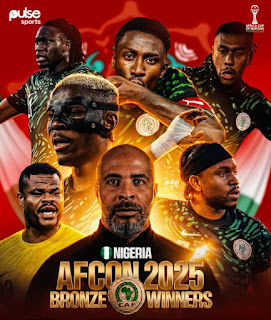
Nigeria’s Super Eagles have once again demonstrated their resilience and fighting spirit on the continental stage, defeating Egypt’s Pharaohs to claim the bronze medal at the 2025 Africa Cup of Nations (AFCON).
In a tense third-place playoff match played on Saturday evening, January 17, 2026, Nigeria overcame the Mohammed Salah-led Egyptian side via a dramatic penalty shootout after a goalless draw in regulation time.
The victory marks Nigeria’s ninth bronze medal in AFCON history and brings a positive conclusion to what has been an intense and emotionally charged tournament campaign.
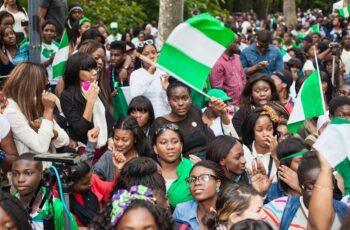
For many Nigerians, the victory also came as a welcome emotional lift after the disappointment of the semi-final loss to Morocco. In offices, viewing centres, and homes across the country, the mood had been sombre following that painful defeat. At my own workplace, colleagues were visibly downcast after the Morocco match, struggling to hide their frustration at how close the Super Eagles had come to reaching the final. Saturday’s win over Egypt, however, changed everything. The bronze medal triumph has restored optimism and brought back the familiar buzz that follows any Super Eagles victory, turning disappointment into celebration once again.
A Battle of African Heavyweights
Few fixtures in African football carry as much weight as Nigeria versus Egypt. Both nations are among the most successful teams in AFCON history and have built reputations as continental powerhouses.
Egypt, the most decorated team in AFCON history, came into the match determined to salvage pride after falling short in the semi-finals. Nigeria, on the other hand, were eager to bounce back from their heartbreaking penalty defeat to Morocco and end the tournament on a winning note.
From kickoff, the encounter lived up to its billing.
Both teams approached the game with urgency, intensity, and discipline, knowing that even though the match was for third place, national pride and legacy were on the line.
Cagey First Half as Both Teams Cancel Each Other Out
The opening half was a tactical battle, with both sides adopting cautious approaches.
Nigeria pressed high and looked to exploit Egypt’s defensive line with quick transitions, while the Pharaohs relied heavily on the creativity of Mohammed Salah and the pace of Omar Marmoush on the wings.
Despite several promising moves, neither side managed to break the deadlock.
Nigeria came closest in the first half when Victor Osimhen found the back of the net following a swift counterattack, only for the goal to be ruled out for offside after a VAR review.
Egypt responded with a flurry of attacks, forcing Super Eagles goalkeeper Stanley Nwabali into a series of crucial saves to keep Nigeria level.
By halftime, both teams had created chances, but neither had found a breakthrough.
Second Half Drama and Disallowed Goals
The second half brought more urgency and attacking intent from both sides.
Nigeria continued to push forward, dominating possession and pressing Egypt deep into their own half. The Super Eagles thought they had finally broken the deadlock midway through the second half when Ademola Lookman slotted home from close range, but once again, the goal was chalked off for offside.
The decision sparked protests from Nigerian players and fans, but the referee stood firm.
Egypt also had their moments, with Salah coming close on two occasions — first with a curling effort that narrowly missed the post, and then with a powerful strike that was brilliantly saved by Nwabali.
As the clock ticked down, both teams threw bodies forward in search of a late winner, but neither side could find the decisive touch.
After 90 minutes of intense football, the scoreline remained 0–0.
Penalty Shootout Drama
With no extra time in the third-place playoff, the match headed straight into a penalty shootout.
The tension inside the stadium was palpable as players from both sides stepped up for one of football’s most nerve-wracking contests.
Nigeria’s first two penalty takers converted confidently, sending the Egyptian goalkeeper the wrong way on both occasions.
Egypt responded with their first spot-kick, calmly dispatched by Salah.
But the momentum shifted dramatically when Super Eagles goalkeeper Stanley Nwabali rose to the occasion.
Nwabali produced a stunning save to deny Salah’s second penalty attempt, diving low to his right to keep the ball out. Moments later, he repeated the feat, stopping Omar Marmoush’s effort and sending Nigerian fans into wild celebration.
With Nigeria converting four of their penalties and Egypt missing two, the Super Eagles sealed a 4–2 shootout victory to claim the bronze medal.
Nwabali Emerges as National Hero
The hero of the night was undoubtedly Stanley Nwabali.
The goalkeeper, who has enjoyed a breakout tournament, capped his AFCON campaign with a performance that will be remembered for years.
His two crucial saves against Egypt’s biggest stars not only secured Nigeria’s victory but also underlined his growing reputation as one of Africa’s most dependable goalkeepers.
Nwabali’s composure, reflexes, and leadership have earned him praise from fans, analysts, and former internationals, with many tipping him as Nigeria’s long-term solution between the posts.
A Redemption Story for the Super Eagles
For the Super Eagles, the bronze medal represents redemption after the disappointment of their semi-final exit.
Nigeria had entered the tournament as one of the favourites, boasting a squad packed with European-based stars and young emerging talents.
Their journey to the semi-finals was marked by disciplined defending, clinical finishing, and tactical maturity. However, their penalty defeat to Morocco in the last four had threatened to overshadow what had otherwise been an impressive campaign.
Saturday’s victory against Egypt ensured the Super Eagles would not leave the tournament empty-handed.
It also reinforced Nigeria’s status as one of Africa’s most consistent footballing nations.
A Tournament of Growth and Promise
Beyond the bronze medal, AFCON 2025 has offered several positives for Nigerian football.
Young players were given opportunities to shine on the big stage, while experienced stars provided leadership and stability.
The team’s defensive organisation, midfield control, and attacking depth showed signs of a side evolving into a well-balanced unit capable of competing for future honours.
Head coach José Peseiro praised his players after the match, commending their mental strength and determination.
“This team showed character,” he said. “After the disappointment of the semi-final, they came back strong. They fought for the country and they deserved this medal.”
What the Win Means for Nigerian Football
Nigeria’s ninth AFCON bronze medal is more than just another trophy for the cabinet. It is a statement of continuity and relevance.
At a time when African football is becoming more competitive than ever, with emerging nations challenging traditional giants, Nigeria continues to prove its pedigree.
The Super Eagles’ ability to consistently reach the latter stages of major tournaments reflects the depth of talent in Nigerian football and the strength of its development system.
For fans, the victory offers hope and optimism ahead of future competitions, including the 2026 FIFA World Cup qualifiers and the next AFCON tournament.
Looking Ahead
As celebrations continue across Nigeria, attention will soon turn to what lies ahead for the Super Eagles.
With a squad blending youth and experience, and a new generation of players coming through, the future looks bright.
The bronze medal at AFCON 2025 may not have been the ultimate prize, but it serves as a reminder that Nigeria remains a force to be reckoned with in African football.
Final Word
In a tournament filled with drama, passion, and unforgettable moments, Nigeria’s victory over Egypt in the third-place playoff stands out as a fitting conclusion to their AFCON 2025 journey.
From the heartbreak of the semi-finals to the joy of penalty shootout triumph, the Super Eagles showed resilience, unity, and belief.
And as Stanley Nwabali’s gloves pushed Egypt’s biggest stars aside, an entire nation was reminded once again why football remains Nigeria’s greatest unifier.
The Super Eagles may have missed out on the AFCON title, but with their bronze medal secured, they leave the tournament with heads held high and eyes firmly fixed on greater glory ahead.
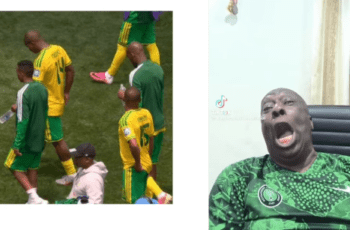
Congratulations
Congrats, but not enough to erase the heartache of world cup disappointment.