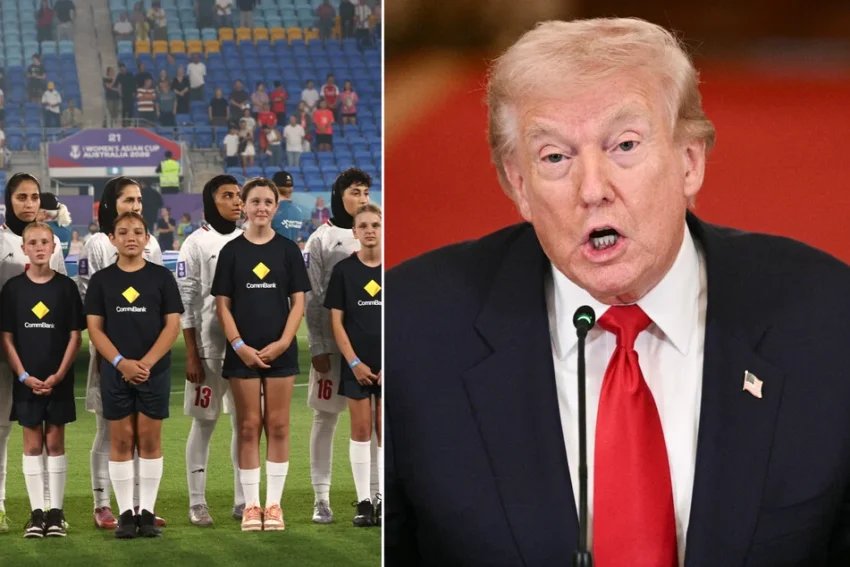
The future of Iran’s women’s national soccer team has become the subject of global concern after the United States President Donald Trump publicly urged Australia to grant the players asylum.
The call came shortly after the team’s elimination from the Women’s Asian Cup tournament held in Australia. While their exit from the competition drew attention on the field, events surrounding the team off the pitch have raised fears about what may happen if the players return home.
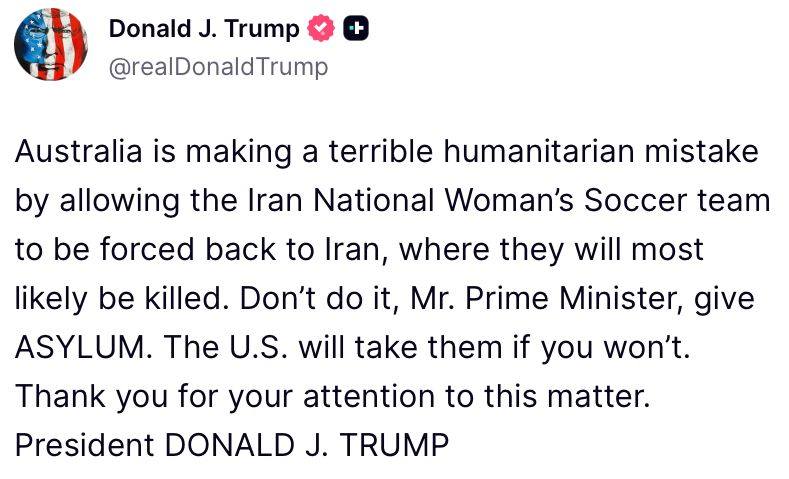
Trump addressed the issue on his social media platform, Truth Social, where he appealed directly to the Australian government to consider the safety of the athletes.
“Australia is making a terrible humanitarian mistake by allowing the Iranian Women’s National Soccer team to be forced back to Iran,” Trump wrote. He warned that the players could face severe consequences once they return to their country.
The situation intensified after reports emerged that the players had been labelled “traitors” by some Iranian media outlets during the tournament.
Controversy During the Tournament
The controversy began during the team’s opening match at the Asian Cup in Gold Coast, Australia. Several players chose not to sing the Iranian national anthem before the game.
The decision immediately attracted attention and criticism from supporters of Iran’s government. In Iran, refusing to sing the anthem during international sporting events is sometimes viewed as a political statement.
Although the players later sang the anthem during their remaining matches in the tournament, the initial moment continued to generate debate online and in Iranian media.
Concerns about the players’ safety grew further after a video circulated showing one of the athletes making what appeared to be an international distress signal while inside the team bus.
According to reports, the player tucked her thumb into her palm and folded her fingers down over it — a hand gesture widely recognized as a silent signal indicating that someone needs help.
The gesture sparked speculation that some members of the team may fear returning to Iran.
Trump’s Appeal to Australia
Reacting to the reports, Trump urged Australian authorities to consider allowing the players to remain in the country if they choose.
“Don’t do it, Mr. Prime Minister. Give asylum,” Trump wrote in his message.
He added that the United States would be willing to accept the athletes if Australia decides not to grant them protection.
“The U.S. will take them if you won’t,” Trump said.
His comments have drawn global attention to the players’ situation and sparked discussions about the responsibilities of host nations when athletes may face risks after international competitions.
FIFA Monitoring the Situation
Football’s governing body, FIFA, confirmed that it is monitoring developments closely.
In a statement released on Monday, FIFA said it remains in contact with Australian authorities and other relevant organisations regarding the team’s circumstances.
The organisation emphasised that the safety and security of players remain a top priority.
The global players’ union, FIFPRO, has also raised concerns about the uncertainty facing the team.
Speaking at the organisation’s general assembly in Sydney, Beau Busch, president of FIFPRO for Asia and Oceania, explained that efforts were being made to ensure the players are able to decide their own future.
Busch said it is important that the athletes have the freedom to determine what steps they want to take next.
“There may be players who want to return home,” he said. “But there may also be players who wish to seek asylum or stay longer while they consider their options.”
He noted that the situation is complicated and requires careful coordination between FIFA, the Asian Football Confederation, and the Australian government.
Wider Tensions in the Region
The concerns surrounding the team come at a time of heightened tensions in the Middle East.
Recent military developments involving the United States, Israel, and Iran have triggered retaliatory actions and increased instability across the region.
These geopolitical tensions have also affected several international sporting events and travel arrangements.
For example, Iraq’s national football team is currently facing uncertainty regarding its upcoming World Cup playoff preparations due to disruptions in the region.
Iraq’s coach, Graham Arnold, has suggested adjusting the schedule of certain matches to allow time for logistical issues to be resolved.
He also raised the possibility that changes to tournament participation could occur if security concerns affect certain teams.
Uncertain Future for the Players
For now, the future of the Iranian women’s national team remains unclear.
Some players may wish to return home once the tournament ends. Others may choose to remain abroad if they feel it is safer to do so.
Sports organisations and government officials are expected to continue discussions in the coming days to determine the best course of action.
The situation highlights how international sports competitions can sometimes intersect with political and humanitarian issues far beyond the playing field.
As global attention grows, the players’ next steps could become one of the most closely watched developments following the tournament.