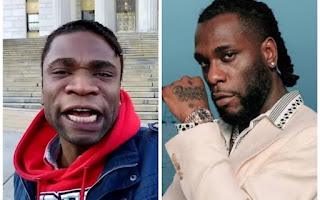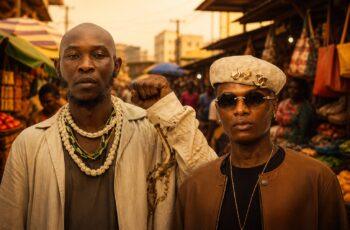
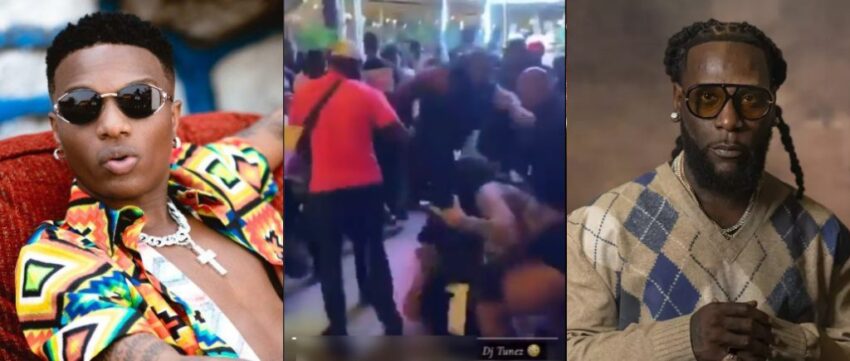
The Nigerian music industry has once again found itself at the center of controversy, this time involving two of its biggest global exports — Wizkid and Burna Boy — alongside DJ Tunez, a long-time associate of Wizkid.
What initially appeared as a social media jab has quickly evolved into a broader conversation about ego, loyalty, power dynamics, and the increasingly tense atmosphere within Afrobeats’ top tier.
What Happened: The DJ Tunez Incident
The situation reportedly began at Obi’s House in Lagos, a popular nightlife spot known for hosting celebrities and industry insiders.
According to circulating claims, Burna Boy and members of his crew confronted DJ Tunez during an outing. While details remain largely unverified and based on insider chatter, the narrative quickly gained traction online, fueled by fan speculation and social media amplification.
DJ Tunez, known for being a close ally and official DJ to Wizkid, has long been part of Wizkid’s inner circle — making any perceived attack on him more than just a random incident.
It became personal.
Wizkid’s Reaction: Subtle Loyalty or Strategic Shade?
Wizkid didn’t stay silent.
Taking to X (formerly Twitter), he responded with a mocking tone, directly taking aim at Burna Boy. His post, laced with humor and insult, referred to Burna as a “babe” and ridiculed his appearance in a video where he wore a towel — which Wizkid sarcastically labeled the “Diddy towel.”
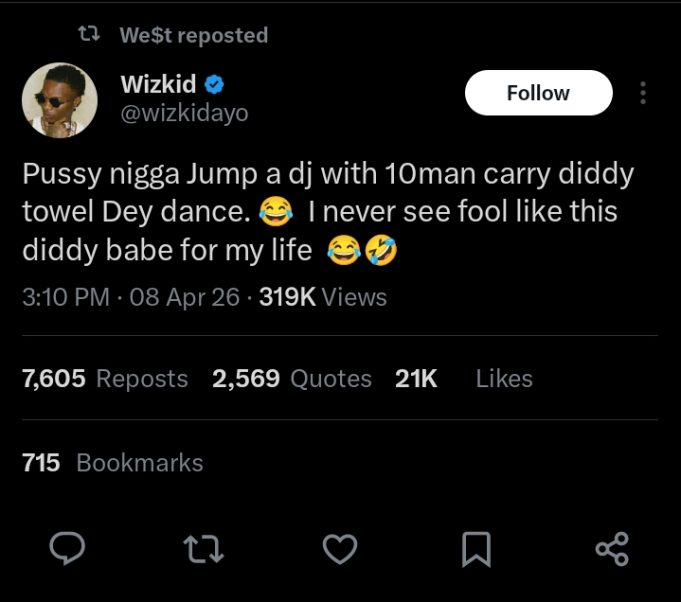
“Pu.ssy nigga jump a DJ with 10 man carry diddy towel dey dance… I never see fool like this diddy babe for my life.”
The tone of the message was unmistakable — this wasn’t just banter. It was a calculated public jab.
Wizkid is known for being selective with his words and appearances online. So when he speaks, especially in a situation like this, it often signals intent rather than impulse.
This raises a key question: was this about defending DJ Tunez, or was it an opportunity to reignite a long-standing rivalry?
Burna Boy: Controversy, Persona, and Power
Burna Boy has built a reputation that extends beyond music.
He is widely recognized not just as an artist but as a personality — one that is bold, unapologetic, and at times, controversial. Over the years, multiple incidents have painted him as someone who doesn’t shy away from confrontation.
While none of the claims surrounding the DJ Tunez incident have been officially confirmed, the public reaction shows how quickly narratives form around artists with existing reputations.
In Burna Boy’s case, every new controversy tends to reinforce an already established image — whether accurate or exaggerated.
A Rivalry That Never Fully Disappeared
Wizkid and Burna Boy are often placed side by side as two of Afrobeats’ biggest global forces.
Both have:
- International recognition
- Grammy wins
- Massive fanbases
- Strong influence on the global sound of African music
However, beneath the surface, there has always been an unspoken rivalry.
It’s not always direct. It doesn’t always play out publicly. But moments like this bring it back into focus.
The comparison is constant:
- Who is the bigger artist?
- Who has more global influence?
- Who represents Afrobeats better?
And while both artists rarely address these comparisons head-on, situations like this indirectly fuel the narrative.
Fan Culture: When Loyalty Turns Toxic
One of the most powerful — and dangerous — aspects of this situation is the role of fanbases.
Wizkid has Wizkid FC.
Burna Boy has a fiercely loyal following of his own.
In today’s digital age, fanbases are no longer passive supporters. They are active participants in shaping narratives.
Once tensions arise between artists, fans often escalate the situation:
- Online insults
- Narrative manipulation
- Viral misinformation
- Digital “wars”
What starts as a disagreement between individuals quickly spreads into a full-blown cultural divide.
This is where things become risky.
Because in Nigeria, online tensions don’t always stay online.
The Bigger Picture: Afrobeats at a Crossroads
Afrobeats is no longer just a Nigerian genre — it is a global movement.
With international collaborations, stadium tours, and streaming dominance, Nigerian artists are now representing an entire continent on the world stage.
But with growth comes pressure.
The industry is becoming:
- More competitive
- More ego-driven
- More commercially intense
And as stakes increase, so do conflicts.
Incidents like this raise concerns about the internal stability of the industry. If top artists are constantly at odds, it creates an environment that can affect:
- Collaborations
- Brand partnerships
- Global perception of the industry
My Opinion: Loyalty, Ego, and Responsibility
From my perspective, Wizkid’s reaction reflects loyalty.
He is known to be proud and reserved, so for him to speak publicly suggests that he felt strongly about the situation involving DJ Tunez.
At the same time, the tone of his response also shows how quickly things can escalate when ego comes into play.
On the other hand, Burna Boy’s name being attached to yet another controversy — whether confirmed or not — points to a recurring pattern that cannot be ignored.
The issue here isn’t just about who is right or wrong.
It’s about responsibility.
These are not just artists anymore — they are global figures. Their actions and words carry weight far beyond music.
My Insight: A Dangerous Pattern in the Industry
The Nigerian music scene is powerful, but it is also becoming increasingly volatile.
Rivalries are no longer just about music — they are about identity, status, and dominance.
Fans pick sides. Narratives deepen. Tensions rise.
And without proper structure or regulation, these issues can spiral.
There is currently no strong industry-wide system to manage conflicts, protect stakeholders, or maintain professionalism among top-tier artists.
If left unchecked, this could lead to:
- More public conflicts
- Industry division
- Reputational damage on a global scale
Breakdown: What This Situation Really Represents
At its core, this isn’t just about Wizkid, Burna Boy, or DJ Tunez.
It represents:
1. Power Dynamics
Top artists operate in circles where influence, loyalty, and reputation are everything.
2. Brand vs Personality
Artists are now brands, but their personal actions still shape public perception.
3. Fan-Driven Narratives
What fans believe and push online can sometimes become “truth,” regardless of facts.
4. Lack of Structure
There is no clear conflict resolution system within the industry.
5. Global Pressure
With Afrobeats on the world stage, every controversy is amplified internationally.
Final Thoughts
The Wizkid–Burna Boy situation is more than just a moment of online drama.
It is a reflection of an industry that is growing fast but struggling to manage its internal tensions.
Both artists have contributed immensely to putting African music on the global map. But moments like this remind us that success also comes with responsibility.
If Afrobeats is to sustain its global rise, there must be a balance between competition and collaboration, between individuality and industry unity.
Because at this level, it’s no longer just about who is the biggest artist.
It’s about what kind of industry Nigeria is building for the future.