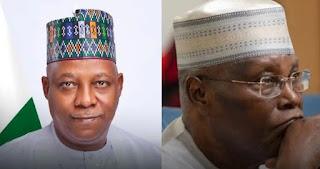
Vice-President Kashim Shettima has questioned former Vice-President Atiku Abubakar’s ability to manage Nigeria’s modern economy, citing his training at the Kano School of Hygiene and criticising his proposal to restore petrol subsidy if elected president in 2027.
Shettima made the remarks on Monday, October 26, at the 32nd Nigerian Economic Summit in Abuja, where he described Atiku’s subsidy proposal as an attempt to reverse economic reforms for political convenience.
“One of the leading presidential candidates (Atiku) is advocating a return to the subsidy scheme. He wants us to backslide into primitivity for political convenience,” Shettima said.
The Vice-President also questioned Atiku’s professional background, arguing that his training in sanitation did not equip him with the skills required to govern a modern economy.
“I dare to put forward that his skill set… he was trained in sanitation at the Kano School of Hygiene. So he doesn’t have the skill set to govern a modern economy. That’s a painful truth,” he said.
Shettima went further by questioning Atiku’s understanding of infectious diseases, referring to the differences between flu, COVID-19 and Ebola. He urged Nigerians to examine the qualifications and policy proposals of political leaders before deciding whom to support.
Shettima Defends Tinubu’s Fuel Subsidy Removal
The Vice-President defended President Bola Tinubu’s decision to remove petrol subsidy, saying the President understood the economic circumstances behind the policy.
“The president took those painful decisions because he understands the dynamics,” Shettima said.
Tinubu announced the removal of petrol subsidy in May 2023. The decision has remained controversial, with the government defending it as a measure to reduce pressure on public finances, while critics point to higher fuel prices and the rising cost of living.
Atiku has advocated a different approach, arguing for the restoration of subsidy under a proposed arrangement. His position has become a point of disagreement between the opposition and the Tinubu administration ahead of the 2027 presidential election.
ADC Campaign Council Responds
The African Democratic Congress (ADC) presidential campaign council criticised Shettima’s remarks, arguing that personal attacks would not address the economic difficulties facing Nigerians.
Phrank Shaibu, the council’s director of strategic communication, defended Atiku’s proposal, describing it as a targeted, capped and independently audited subsidy arrangement tied to petrol refined in Nigeria.
Shaibu challenged the government to explain how its economic policies were improving living conditions and argued that political debate should focus on practical solutions to the cost of living.
The exchange highlights the competing economic positions likely to feature prominently in the run-up to the 2027 general election, particularly the debate over petrol prices, public spending and how best to protect households from rising costs.