
By Desmond Ogbonmwan
For many Nigerians returning from South Africa following renewed anti-immigrant tensions, the memories they carry home extend far beyond abandoned businesses or interrupted careers.
Some speak of years spent living in fear.
Others describe struggling to find stable employment despite working hard to build a better future.
For Ilugbadebo Oyebola, however, one of the most painful memories dates back to the birth of her first daughter—a moment she says should have been filled with joy but instead became one of the most traumatic experiences of her life.
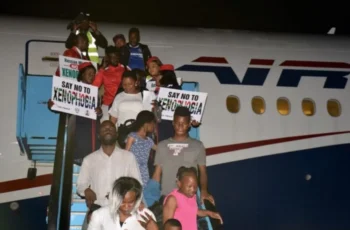
Speaking shortly after arriving in Nigeria as part of the latest government-assisted evacuation, Oyebola alleged that she was instructed by a nurse to clean blood from the hospital floor immediately after giving birth because she was identified as a foreigner.
Her account has renewed conversations about the experiences many migrants say they face while trying to access healthcare services abroad, particularly during periods of heightened anti-immigrant sentiment.
It is important to note that these are Oyebola’s personal allegations, shared during an interview after her return to Nigeria. RoseOnAllSidesHQ has not independently verified the specific incident or obtained a response from the healthcare facility where it allegedly occurred.
Eleven Years Away From Home
According to Oyebola, she relocated to South Africa in 2015 with her son after joining her husband, who had already settled in the country.
Like many migrants seeking better economic opportunities, she hoped to establish a stable life and contribute to her family’s future.
Instead, she says the years that followed were marked by uncertainty.
She explained that she struggled to obtain stable employment because she did not possess a work permit, limiting the opportunities available to her despite living in the country for more than a decade.
She described the experience as emotionally exhausting, saying the challenges extended beyond employment and affected many aspects of daily life.
A Childbirth Experience She Says She Will Never Forget
Among the many experiences she shared, none appeared more painful than her account of giving birth to her first daughter in South Africa.
According to Oyebola, shortly after delivery she began bleeding heavily, leaving blood on the hospital floor.
She alleges that a nurse approached her and initially spoke in a local South African language.
When she could not understand or respond, the nurse allegedly realised she was not South African.
It was at that point, Oyebola claims, that she was instructed to clean the blood herself despite having just given birth.
Recalling the incident, she described it as one of the most humiliating moments of her life.
“You can imagine the trauma,” she said while reflecting on the experience.
For many mothers, childbirth is already one of the most physically demanding experiences they will ever endure.
Being asked to carry out physical cleaning immediately afterwards, if true, would understandably leave lasting emotional scars.
Healthcare and Migration: A Difficult Intersection
Oyebola’s account has reignited broader conversations about the challenges migrants sometimes face when accessing healthcare services in foreign countries.
Healthcare professionals around the world are generally expected to provide treatment without discrimination based on nationality, ethnicity or immigration status.
However, migrant rights organisations have, over the years, documented reports from different parts of the world where foreign nationals have alleged unequal treatment, language barriers or difficulties accessing medical care.
These experiences vary widely and should not be interpreted as representing every hospital or healthcare worker in a particular country.
Many migrants also report receiving professional and compassionate care from healthcare providers.
Nevertheless, allegations such as Oyebola’s highlight why equal access to healthcare remains an important issue in discussions about migration and human rights.
Language Barriers Can Deepen Feelings of Isolation
One detail in Oyebola’s account that resonated with many listeners was the role language appeared to play.
She said the nurse initially communicated in a local language and only changed her behaviour after realising she could not respond.
Language barriers frequently complicate healthcare delivery across the world.
Patients who cannot communicate effectively with medical staff may struggle to explain symptoms, understand treatment instructions or advocate for themselves.
For migrants already navigating unfamiliar systems, the inability to speak the dominant language can increase feelings of vulnerability and isolation.
Hospitals in multicultural societies often rely on interpreters or multilingual staff to reduce these challenges, though access to such services varies significantly.
More Than a Medical Story
Oyebola’s experience is not simply a story about one hospital visit.
It reflects the broader reality that many migrants describe when discussing life far from home.
For some, the greatest challenge is not finding work or adapting to a new culture.
It is the feeling of being treated differently because they are perceived as outsiders.
Whether in schools, workplaces, neighbourhoods or healthcare facilities, such experiences can shape how migrants remember the countries in which they once hoped to build new lives.
For Oyebola, the emotional impact appears to have remained long after the physical recovery from childbirth.
Childbirth Should Never Be a Traumatic Experience
Medical professionals around the world recognise childbirth as one of the most physically and emotionally demanding experiences a woman can go through.
Beyond the delivery itself, new mothers require close medical observation, emotional support and adequate time to recover.
When a woman says she experienced humiliation or discrimination during that period, the emotional impact can last long after the physical wounds have healed.
Health experts have consistently noted that respectful maternity care is an important part of quality healthcare.
Treating women with dignity during pregnancy, labour and recovery not only improves their experience but can also influence their willingness to seek medical care in the future.
Although hospitals everywhere strive to maintain professional standards, reports from different countries have shown that some migrant women believe they face additional barriers because of language, immigration status or perceived nationality.
Why Migrant Healthcare Remains a Global Challenge
The experiences described by Oyebola are not unique to one country.
Around the world, migrants sometimes report challenges when accessing healthcare, particularly where language barriers, documentation issues or social tensions exist.
International organisations, including the World Health Organization (WHO), have repeatedly stressed that access to essential healthcare should be guided by medical need and professional ethics rather than nationality or immigration status.
In practice, however, the experiences of migrants vary considerably.
Many foreign nationals report receiving compassionate, professional care in their host countries.
Others describe difficulties ranging from communication challenges to long waiting times, uncertainty about eligibility for services or experiences they believe amounted to discrimination.
These differing experiences highlight the importance of strong healthcare systems, cultural awareness and effective communication between patients and healthcare providers.
Trauma Does Not End After Leaving the Hospital
Physical recovery after childbirth may take weeks.
Emotional recovery can take much longer.
Psychologists explain that deeply distressing experiences during childbirth may affect how mothers remember the event for years.
Some women develop anxiety about future pregnancies.
Others struggle with feelings of fear, shame or helplessness.
For migrants living far from extended family and familiar support systems, those emotional burdens can feel even heavier.
Without close relatives nearby, many women depend entirely on their spouses, friends or community groups during one of the most vulnerable periods of their lives.
When those moments are overshadowed by alleged mistreatment, rebuilding confidence may require significant emotional support.
Returning Home With Mixed Emotions
For Oyebola, returning to Nigeria appears to represent both relief and uncertainty.
After spending 11 years in South Africa, she is no longer simply returning to the country she left behind.
She is beginning another chapter of life.
Like many returnees, she now faces practical questions.
How does a family rebuild after more than a decade abroad?
How easy will it be to secure employment?
What happens to relationships, friendships and businesses left behind?
These are questions confronting many Nigerians arriving on recent evacuation flights.
Their stories demonstrate that migration is rarely as simple as leaving one country and arriving in another.
Every move carries emotional, financial and social consequences.
Why Personal Testimonies Matter
Individual accounts like Oyebola’s play an important role in helping the public understand the human side of major events.
Statistics can tell us how many people were evacuated.
Government statements can explain official policy.
But personal testimonies reveal how ordinary people experience those events.
At the same time, individual experiences should be understood as personal accounts rather than evidence that every migrant or every healthcare institution has acted in the same way.
Recognising this distinction allows important conversations to take place without unfairly generalising about an entire country or profession.
A Broader Conversation About Human Dignity
The latest evacuations from South Africa have prompted discussions about migration, security and diplomacy.
Oyebola’s account adds another dimension.
It reminds us that the conversation is also about dignity.
Every person—regardless of nationality, ethnicity or immigration status—deserves to be treated with respect, particularly when seeking medical care.
That principle forms part of internationally recognised healthcare ethics and remains central to discussions about human rights across the world.
As governments continue addressing the political aspects of migration, stories like this encourage equal attention to the everyday experiences of individuals whose lives are directly affected.
Final Thoughts
For many Nigerians returning from South Africa, the journey home is about much more than geography.
It is about carrying memories that cannot be packed into a suitcase.
For Ilugbadebo Oyebola, one of those memories is the birth of her daughter—a day she says became one of the most painful experiences of her life because of the way she believes she was treated.
Whether through diplomatic engagement, improved healthcare policies or stronger protections for migrants, stories like hers highlight the importance of ensuring that every person is treated with dignity during moments of vulnerability.
As Nigeria continues receiving returnees from South Africa, their experiences will contribute to a broader understanding of what life abroad has meant for many migrants—both the opportunities they found and the challenges they say they endured.
Frequently Asked Questions
Why was Ilugbadebo Oyebola repatriated?
She was among Nigerians who returned to Nigeria following renewed anti-immigrant tensions and government-assisted evacuation flights from South Africa.
What did she allege happened at the hospital?
Oyebola alleged that after giving birth, she was instructed by a nurse to clean blood from the hospital floor after being identified as a foreigner. Her account has not been independently verified by RoseOnAllSidesHQ, and no response from the hospital was available at the time of publication.
Are all migrants treated the same way in South African hospitals?
No. Experiences vary widely. Many migrants report receiving professional healthcare, while others have shared accounts of difficulties or alleged discrimination. Individual experiences should not be taken as representative of every healthcare facility or healthcare worker.
Why is migrant healthcare an important issue?
Access to healthcare affects public health, maternal wellbeing and human dignity. International health organisations advocate equitable access to essential medical services regardless of nationality.
Why is this story significant?
It provides a personal perspective on the broader challenges some migrants say they face while living abroad and adds human context to ongoing discussions about migration, xenophobia and the treatment of foreign nationals.
Related Stories
FG Seeks Compensation for Nigerians’ Abandoned Properties as South Africa Evacuation Continues
Why Xenophobic Attacks Keep Returning in South Africa: Understanding the Causes and Impact
How Nigerian-Owned Businesses Have Helped Shape South Africa’s Economy
The Human Cost of Starting Over After Forced Migration
Photos: Second Batch of Nigerians Evacuated From South Africa Arrive Lagos