
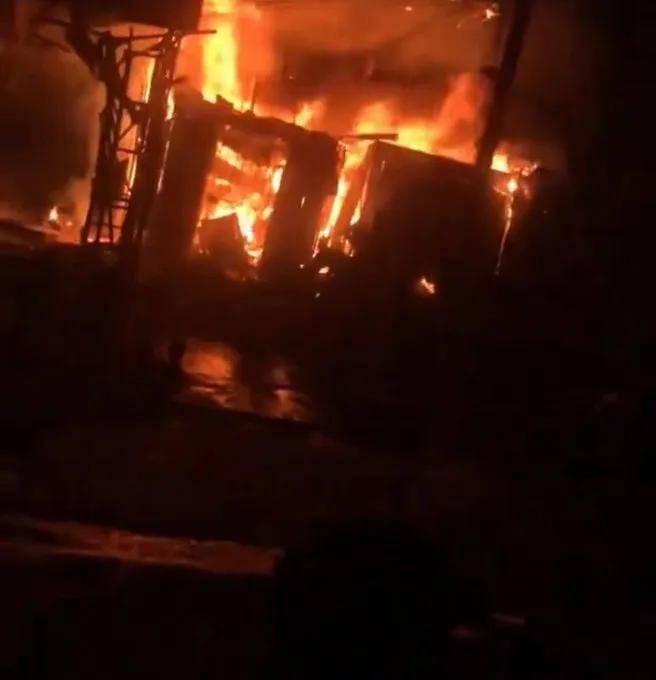
If you’ve been paying attention lately, it feels like every other week we’re hearing the same kind of headline: “Fire outbreak destroys shops… goods worth millions lost…” And the scary part isn’t only the money it’s that most of these fires happen late at night or very early in the morning, when people are asleep, when help is slower, and when the fire has enough time to spread before anyone can stop it.
Just this week, a fire hit a one-storey building inside Computer Village, Ikeja, destroying goods worth millions of naira. Officials said the building contained computer dealers and accessories, and that the fire spread fast because of the kind of materials inside. The cause wasn’t confirmed at the time of the report.
Around the same period, another report showed shops at the Old Market in Sokoto were razed by fire, with goods and property destroyed and the cause still unknown at the time.
And if we look back a bit, we’ve seen cases like Bariga Market in Lagos, where at least 26 shops were affected in one incident, with reports pointing to how quickly fire can spread when shops are built with materials that catch fire easily.
So the question many people are asking is simple:
Why is it happening so often? And why does it always seem to be markets, plazas, shopping complexes, and places where goods are packed together?
Let’s break it down in plain language.
The Real Reasons Market Fires Spread Like Wildfire
1) Power problems + bad wiring = danger
This one is not even a debate. Many shopping areas run on a mix of public power, generators, and small connections that aren’t properly installed.
When light goes off and comes back suddenly, the power can “hit” hard. If wiring is weak, that shock can trigger sparks. If there are cartons, nylon, wood partitions, fuel, foam packaging, it becomes fire in seconds.
In fact, some official reports about market fires have linked incidents to electrical surge and negligence.
2) Too many flammable things in one place
Markets and tech hubs are full of:
cartons and packaging
plastics and nylon
extension boxes
batteries and chargers
fuels and generator storage nearby
wood partitions used to build shop sections
Once fire starts in places like that, it doesn’t “burn small”. It grows fast.
That’s why, in the Computer Village case, responders pointed out that the kind of materials inside helped the fire spread quickly.
3) Locked shops and no quick access
A lot of markets lock up tight at night. So even when people notice smoke, the problem is:
Nobody has keys
Firefighters can’t enter quickly
Fire has time to spread from one shop to the next
4) Poor spacing + blocked pathways
Many market layouts are tight, with little space between structures. Some shops block emergency paths. Sometimes, even fire trucks struggle to enter certain areas.
Even if firefighters arrive, getting water close to the fire can be a problem.
5) No working fire tools inside shops
Let’s be honest: many shop owners don’t keep fire extinguishers, or they do but it’s expired, or they don’t know how to use it.
And in many cases, one small extinguisher used early can stop a fire from becoming a disaster.
The Shops/Markets That Have Been Hit Recently (Examples)
Here are some recent cases reported by credible media:
Computer Village, Ikeja (Somoye Osundairo Street) – one-storey commercial building with computer dealers; goods destroyed; cause still under investigation at time of report.
Sokoto Old Market – several shops razed; goods lost; cause not confirmed at time of report.
Bariga Market, Lagos – at least 26 shops affected; heavy losses reported; cause not confirmed at time of report.
Shopping complex near Ikotun Roundabout, Lagos – reports mentioned a storey shopping complex with multiple shops affected (many containing electronics), and preliminary investigations pointing to electrical issues.
Great Nigeria Insurance Plaza / Balogun Market area (Lagos Island) – major fire incident reported around the Yuletide period with serious losses and casualties reported in updates.
(If you want, paste any other fire stories you’ve posted recently and I’ll add them into this list cleanly.)
The “Popular Opinion” People Keep Whispering: Are Some Shops Being Targeted?
Now let’s address the part many people are talking about — especially traders.
There’s a popular opinion (and yes, it’s alleged) that some of these repeated fires are not fully “accidents.” People claim it feels like certain locations are being hit repeatedly, and some traders suspect the fires may be connected to:
attempts to chase people away from prime areas
plans to redevelop certain markets or buildings
land and rent battles
property takeover after damage
insurance-related motives (people argue about this a lot)
To be very clear: there is no confirmed proof in the reports we have that these fires are planned attacks, and many times officials say the cause is unknown or linked to electrical faults.
But the suspicion exists because:
It keeps happening frequently
It often happens at odd hours
It often affects places with valuable goods
People don’t always see clear investigation outcomes made public
So traders start connecting dots on their own.
That said, it’s important to keep it honest: suspicion is not the same as evidence. A fire can feel “set up” when it destroys everything you own — but investigations are what separate truth from rumours.
Still, these rumours are loud for one reason: people are tired. When someone loses their shop today, rebuilds, and then another fire hits a different market tomorrow, it starts looking like a pattern — even if it isn’t.
What Needs to Change (If We Don’t Want This to Continue)
If we’re serious about reducing market fires, these are the practical things that matter:
For shop owners:
Stop leaving charging devices overnight
Reduce the number of extensions plugged into each other
Use proper wiring (not roadside connections)
Keep at least one fire extinguisher in each shop and learn how to use it
Avoid storing fuel close to goods
Lock shops properly but ensure there’s emergency access plan for security
For market leaders and government:
Regular wiring checks
Enforce safe shop partitions and spacing
Create proper access routes for fire trucks
Install fire alarms and water points where possible
Publish investigation findings more clearly, so rumours don’t take over the truth
Because once people stop trusting that the real cause will be found, conspiracy theories grow faster than the fire itself.
Final Note
Whether these fires are accidents, negligence, electrical problems, or something more — one thing is clear: too many people are losing their livelihoods at once. And until prevention becomes a serious priority, these stories will keep repeating.