

By Desmond Ogbonmwan
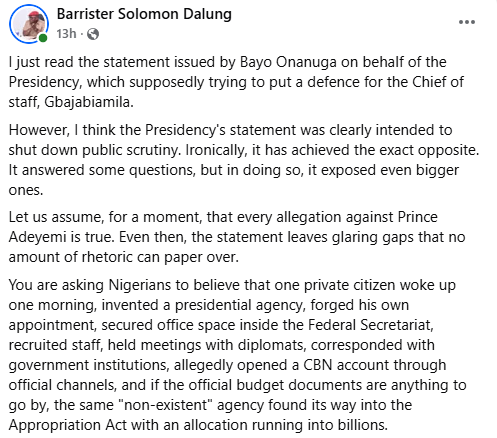
Former Minister of Youth and Sports, Solomon Dalung, has raised fresh questions over the Presidency’s explanation of the alleged activities of Prince Adeniyi Adeyemi Matthew, the man accused of posing as the head of a non-existent presidential agency.
Rather than disputing only the allegations against Adeyemi, Dalung argued that the Presidency’s own statement raises broader concerns about how Nigeria’s government institutions function.
His central question is straightforward: if the agency never existed, how was it allegedly able to operate within official circles for months without being detected?
Dalung’s comments come a day after presidential spokesman Bayo Onanuga released a detailed statement outlining the government’s position on the ongoing criminal case involving Adeyemi, who faces allegations including forgery, impersonation and obtaining by false pretence.
The case is currently before the courts, and the allegations remain subject to judicial determination.

Dalung Says the Presidency Answered Some Questions—but Raised More
Reacting to the Presidency’s statement, Dalung said the government appeared focused on defending the Office of the Chief of Staff while leaving several important governance issues unresolved.
According to him, even if every allegation against Adeyemi were eventually proven in court, Nigerians would still deserve explanations about how the alleged scheme was able to function within official institutions.
He argued that the matter extends beyond the conduct of one individual and instead raises questions about administrative oversight across multiple government agencies.
“If the council was fake, explain how it entered the budget?” Dalung asked, referring to what he said was the appearance of the purported agency in official budget documents.
At the time of his statement, Dalung did not provide documentary evidence publicly to support that assertion, and the Presidency’s response did not address the budget claim directly.
Questions About Government Oversight
Dalung listed several issues he believes require further explanation.
Among the questions he raised were:
- How could someone allegedly establish a non-existent presidential agency?
- How was office space reportedly obtained within the Federal Secretariat?
- How were meetings with diplomats allegedly organised without earlier intervention?
- How did official correspondence allegedly move through government institutions?
- How was a purported Central Bank-related account reportedly opened?
- If the agency appeared in budget documents, who authorised the entry?
He argued that these questions concern institutional accountability rather than partisan politics.
According to Dalung, if government procedures were bypassed so extensively, understanding how that occurred is essential to preventing similar incidents in the future.
The Budget Question
Perhaps the strongest issue raised by the former minister concerns the national budget.
Dalung argued that federal budget proposals typically pass through several layers of review before becoming law, including:
- preparation by ministries and government agencies;
- review by the Budget Office;
- consideration by the Federal Executive Council;
- approval by the National Assembly;
- presidential assent.
Because of that process, he questioned how a supposedly fictitious agency could allegedly appear in official budget documentation if it had no legal existence.
The Presidency’s statement focused primarily on the criminal investigation and did not directly respond to this specific claim.
Whether the purported agency appeared in an Appropriation Act or other budget-related documents is a matter that would require independent verification through official records.
A Broader Governance Debate
Dalung’s intervention shifts the public discussion from the criminal allegations against Adeyemi to the effectiveness of institutional safeguards within government.
His argument is that even if investigators successfully prove forgery and impersonation, the case still raises important governance questions.
For example, how do government agencies verify official correspondence?
What internal controls exist to prevent unauthorised individuals from interacting with public institutions?
How quickly should suspected irregularities be detected?
These are questions that extend beyond one criminal case and touch on broader issues of public administration.
Why This Matters Beyond Politics
Cases involving alleged impersonation of government officials have consequences that reach beyond political debate.
Public confidence in state institutions depends on citizens believing that official appointments, correspondence and agencies can be trusted.
If weaknesses exist in verification procedures, they can create opportunities for fraud, misrepresentation and reputational damage.
Whether those weaknesses were present in this case is likely to remain part of public discussion as court proceedings continue.
How Nigeria’s Budget Process Works
One of the central issues raised by Solomon Dalung concerns how a government agency is created and funded.
Under Nigeria’s public finance system, federal budget allocations are generally not inserted casually. Budget preparation involves multiple stages before becoming law.
The process typically includes:
- Ministries, Departments and Agencies (MDAs) preparing budget proposals;
- review by the Budget Office of the Federation;
- consideration by the Federal Executive Council (FEC);
- submission of the Appropriation Bill to the National Assembly;
- scrutiny by relevant Senate and House of Representatives committees;
- passage by both chambers of the National Assembly;
- presidential assent.
Because several institutions participate in this process, Dalung argues that any appearance of a non-existent agency in budget documents would raise legitimate questions about internal oversight.
Whether that occurred in this case is a matter that can be confirmed only by examining official budget records.
Can a Non-Existent Agency Appear in the National Budget?
In principle, government agencies that receive public funding are expected to have a legal or administrative basis for their existence.
However, governance experts note that administrative errors, changes in agency structures or documentation issues can sometimes occur within large public institutions.
That is why Dalung’s question has attracted attention.
If official records eventually show that the alleged agency appeared in budget documents, investigators and oversight institutions would likely seek to determine:
- who proposed the budget line;
- whether it passed through normal administrative checks;
- whether the listing resulted from an administrative error or something more serious;
- whether public funds, if any, were actually released.
At the time of writing, the Presidency has not publicly addressed Dalung’s specific budget-related claim.
What Safeguards Are Supposed to Prevent This?
Government systems are designed with multiple layers of verification intended to reduce the risk of fraud or unauthorised activity.
These safeguards generally include:
- verification of official correspondence;
- authentication of appointment letters;
- internal approval procedures;
- financial oversight before public funds are released;
- security screening for sensitive appointments;
- periodic audits by oversight institutions.
When questions arise about whether these safeguards worked as intended, they often become matters for investigators, auditors or legislative oversight bodies.
Dalung’s criticism is essentially that the public deserves to know whether existing safeguards functioned properly in this instance.
The Presidency’s Position Versus Dalung’s Questions
Although both parties are discussing the same incident, they are focusing on different issues.
The Presidency’s statement concentrates on the criminal allegations against Adeyemi, maintaining that:
- the purported agency did not exist;
- the appointment letter was allegedly forged;
- investigations were initiated after concerns were reported;
- the matter is now before the Federal High Court.
Dalung, however, argues that this explanation addresses only part of the story.
His position is that Nigerians also deserve an explanation of how government institutions allegedly interacted with someone now described as an impostor.
In other words, the Presidency is emphasising individual criminal responsibility, while Dalung is emphasising institutional accountability.
These are separate issues, and both may continue to feature in public debate as the court case progresses.
Why Institutional Accountability Matters
Whether in Nigeria or elsewhere, public confidence in government depends on strong institutions as much as on individual office holders.
When allegations suggest that official procedures may have been bypassed, citizens naturally ask whether existing systems are adequate.
Questions about:
- document verification;
- access to government facilities;
- financial controls;
- communication between agencies;
- oversight mechanisms;
are important because they affect the credibility of public administration beyond this single case.
Addressing those questions openly can strengthen confidence in government institutions, regardless of the eventual outcome of the criminal proceedings.
The Importance of Due Process
While the political debate continues, the legal case remains before the Federal High Court.
This distinction is important.
Political criticism and public commentary are part of democratic accountability, but criminal liability can only be determined through the judicial process.
During the trial:
- prosecutors will present evidence;
- the defence will have the opportunity to respond;
- witnesses may be examined;
- the court will determine whether the allegations have been proved.
Until then, all accused persons remain entitled to the presumption of innocence under Nigerian law.
Why This Story Matters
This case has evolved beyond allegations of forgery or impersonation.
It has become part of a wider conversation about transparency, institutional oversight and public accountability.
For many Nigerians, the key questions are no longer limited to whether one individual acted unlawfully.
They also include:
- How resilient are government verification systems?
- Could similar incidents happen again?
- What reforms might strengthen institutional safeguards?
- How should government respond when oversight failures are alleged?
These questions will likely remain relevant regardless of the court’s eventual decision.
Final Thoughts
Solomon Dalung’s response has shifted public attention from the alleged actions of one individual to the broader functioning of government institutions.
By questioning how a purportedly fictitious agency could allegedly interact with multiple public offices—and by asking whether it appeared in official budget documents—he has introduced issues that extend beyond criminal prosecution into the realm of governance and accountability.
The Presidency maintains that the alleged agency never existed and that the matter is already before the courts.
Dalung, meanwhile, argues that Nigerians deserve fuller explanations about how government systems responded to the alleged scheme.
As legal proceedings continue, the answers that emerge may shape not only the outcome of the criminal case but also future discussions about transparency and institutional reform within Nigeria’s public sector.
Frequently Asked Questions
Why is Solomon Dalung questioning the Presidency?
Dalung argues that the Presidency’s statement focused on the criminal allegations against Adeyemi but did not fully explain how the alleged fake agency reportedly interacted with several government institutions.
Did Dalung prove the agency appeared in the national budget?
Dalung claimed the purported agency appeared in budget documents, but that assertion has not been independently verified in the information currently available. The Presidency’s statement did not directly address the claim.
Is the case still before the court?
Yes. According to the Presidency, criminal charges have been filed before the Federal High Court in Abuja, and the matter is awaiting further proceedings.
Has anyone been convicted?
No. At the time of publication, the allegations remain before the court, and no conviction has been recorded. All defendants are presumed innocent unless proven guilty.
Why is this case significant?
Beyond the criminal allegations, the case has sparked debate about government oversight, document verification, institutional accountability and the safeguards designed to prevent unauthorised individuals from presenting themselves as public officials.
Related Stories
- Presidency Disowns Man Allegedly Posing as Head of Fake Presidential Agency: What We Know So Far
- What the ICPC Does and How It Investigates Corruption Cases in Nigeria
- What Happens After an Arrest by the ICPC? A Step-by-Step Guide
- How Certificate Verification Works for Nigerian Public Officials
- Timeline: Major Certificate Forgery Cases Involving Nigerian Public Officials